
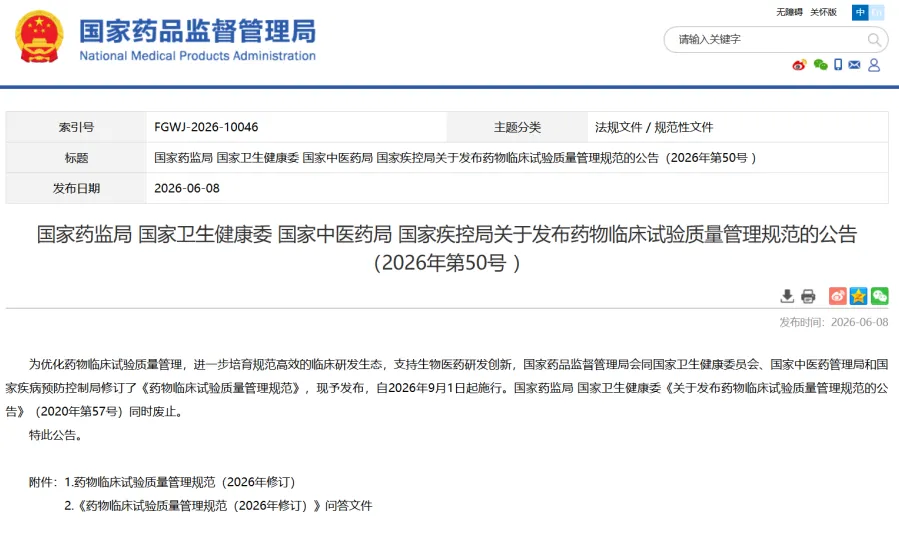
Today (June 8), in order to optimize the quality management of drug clinical trials, further cultivate a standardized and efficient clinical R&D ecosystem, and support biopharmaceutical R&D innovation, the National Medical Products Administration, together with the National Health Commission, the National Administration of Traditional Chinese Medicine, and the National Disease Control Administration, issued the revised Good Clinical Practice for Drug Trials (Announcement No. 50 of 2026).
The new edition of GCP fully incorporates the core concepts of ICH E6(R3), emphasizing the principles of "quality-by-design" and proportionality. It consists of 6 chapters—General Provisions, Ethics Committee, Principal Investigator and Drug Clinical Trial Institution, Sponsor, Data Governance, and Supplementary Provisions—with 54 articles, and introduces a dedicated chapter on "Data Governance" for the first time. The revision further strengthens the ultimate responsibility of sponsors and principal investigators, optimizes ethics review and safety reporting processes, clarifies the validity of electronic signatures, and aligns with the Drug Administration Law and the ethics review provisions of the health authorities.
It is hereby issued and shall take effect on September 1, 2026.
Annex 1
Good Clinical Practice for Drug Trials (2026 Revision)
Chapter I General Provisions
Article 1 This GCP is formulated in accordance with the Drug Administration Law of the People's Republic of China, the Vaccine Administration Law of the People's Republic of China, the Implementing Regulations of the Drug Administration Law of the People's Republic of China, and the Provisions for Drug Registration, in order to ensure the standardization of drug trial processes, protect the rights, interests, and safety of trial participants, and ensure that data and results are scientific, authentic, and reliable.
Article 2 This GCP applies to drug clinical trials conducted for the purpose of drug development that have been approved or filed with the drug regulatory authority under the State Council. All activities related to drug clinical trials shall comply with this GCP.
Article 3 Good Clinical Practice is an ethical, scientific, and quality standard that should be followed throughout the entire process of drug clinical trials. The entire process includes planning, initiation, execution, recording, monitoring, evaluation, analysis, and reporting.
Article 4 Drug clinical trials shall comply with the principles of the World Medical Association Declaration of Helsinki and relevant ethical requirements. The rights, interests, and safety of trial participants are the primary considerations, taking precedence over the benefits to science and society. Ethical review and informed consent are important measures to safeguard the rights, interests, and safety of trial participants.
Article 5 Drug clinical trials shall be scientifically sound and reasonable, weighing the anticipated risks and benefits to trial participants and society. A trial may be initiated or continued only when the anticipated benefits justify the risks.
Article 6 The design and conduct of clinical trials shall incorporate a quality-by-design approach, identify critical quality factors and associated risks, and implement proportionate risk control measures to protect the rights, interests, and safety of trial participants and ensure reliable results.
Article 7 The clinical trial protocol shall be clear, concise, scientifically sound, reasonable, and operational. It may only be implemented after obtaining approval from the ethics committee. During trial implementation, if necessary to ensure ethics and scientific validity, the protocol may be amended, but may only be implemented after re-approval by the ethics committee.
Article 8 All parties involved in a clinical trial shall have the appropriate educational background, training experience, and practical experience to undertake clinical trial work, and shall comply with the trial protocol during the trial. Roles and responsibilities in the clinical trial shall be clearly defined and properly documented. Any medical judgment or medical decision-making shall be made by qualified clinicians.
Article 9 All paper and electronic documents from clinical trials shall be properly recorded, processed, and preserved to ensure data reliability and traceability. The privacy and personal information of trial participants shall be protected in accordance with China's relevant requirements on personal information protection.
The systems and processes used for data collection, management, and analysis shall be fit for their intended purpose and proportionate to the risks to trial participants and the importance of the data collected.
Article 10 The preparation of investigational products shall comply with relevant quality management requirements for the manufacture of investigational medicinal products. Their use and management shall comply with laws, regulations, and the trial protocol and related documents.
Article 11 Quality management for drug clinical trials shall run throughout the entire process to protect the rights, interests, and safety of trial participants, ensure the reliability of clinical trial results, and comply with relevant laws and regulations.
Article 12 The conduct of drug clinical trials shall adhere to the principle of conflict of interest avoidance to avoid any impact on the rights, interests, and safety of trial participants, as well as the reliability of trial results.
Article 13 The use of new technologies and methods in drug clinical trials shall comply with ethical, scientific, and relevant legal and regulatory requirements.
Chapter II Ethics Committee
Article 14 The responsibility of the ethics committee is to protect the rights, interests, and safety of trial participants. The ethics committee shall review both the ethical and scientific aspects of the clinical trial, with special attention to the protection of vulnerable trial participants. The ethics review conducted by the ethics committee shall comply with the relevant provisions of the competent health authorities and the requirements of this GCP.
(1) Documents reviewed by the ethics committee include: the trial protocol, informed consent form, methods and information for recruiting trial participants, other materials provided to trial participants, investigator's brochure and current scientific information, safety data, documents containing compensation information for trial participants, qualification documents of the principal investigator, reports of important protocol deviations, progress and final reports, and other documents needed for the ethics committee to fulfill its responsibilities.
(2) The ethics committee shall pay special attention to the following exceptional circumstances and review whether the protection of the rights, interests, and safety of trial participants is adequate:
When trial participants are enrolled in a clinical trial with no anticipated benefit and informed consent is provided by their legally authorized representative.
When trial participants are persons without civil capacity or with limited civil capacity.
When minors are involved, the ethics committee shall review the informed consent information for minors, taking into account the participants' age characteristics, cognitive maturity, psychological state, and applicable regulatory requirements.
When the protocol clearly states that participants may be enrolled in emergency situations where neither the participant nor their legally authorized representative can sign the informed consent form prior to the trial.
(3) The ethics committee shall review to ensure that there is no coercion, inducement, or other means that may influence participants' decision to participate in the clinical trial. The ethics committee shall review that the informed consent form does not contain any content requiring participants or their legally authorized representatives to waive their legal rights, nor any content that would exempt the principal investigator, clinical trial institution, sponsor, or related service providers from liability.
(4) The ethics committee shall ensure that the compensation information for trial participants contained in the informed consent form and other materials provided to participants, including the method, amount, and plan of compensation, is reasonable.
(5) The ethics committee shall focus on and promptly review the following situations: serious adverse events reported by the principal investigator during the clinical trial; deviations from or modifications to the trial protocol made during implementation to eliminate immediate hazards to trial participants; serious and persistent non-compliance issues; changes that increase risks to participants or significantly affect trial implementation; and new information that may have an adverse impact on participant safety or trial implementation.
The ethics committee's review of suspected unexpected serious adverse reactions, other potential serious safety risk information, and information related to development safety update reports reported by the sponsor shall be proportionate to the urgency of the measures to be taken and the changes in the safety profile of the investigational product.
(6) The ethics committee shall conduct periodic ongoing review of ongoing clinical trials. The frequency of review shall be based on the risk level of the trial, with intervals not exceeding 12 months.
(7) The ethics committee shall complete the review or filing process for clinical trial documents within a reasonable time frame and issue clear written review opinions or filing receipts containing version information of the reviewed documents. The ethics committee's review opinions include: approval, disapproval, approval subject to modifications, re-review after modification, continuation, suspension, or termination of the study.
(8) The ethics committee has the authority to suspend or terminate clinical trials that are not being conducted in accordance with relevant requirements, or in which participants experience unexpected serious harm.
(9) The ethics committee shall accept and properly handle relevant requests from trial participants.
Article 15 The ethics committee shall establish an ethics review work system and standard operating procedures, improve the conflict of interest management mechanism and ethics review quality control mechanism, and ensure that the ethics review process is independent, objective, and impartial.
Article 16 The ethics committee shall retain all records of ethics review, including written records of ethics review, committee member information, submitted documents, meeting minutes, and relevant correspondence records. For clinical trials used for drug registration applications, all records shall be retained for at least 5 years after the investigational drug is approved for marketing; for clinical trials used for drug registration applications where the drug is not approved, and for clinical trials not used for drug registration applications, all records shall be retained for at least 5 years after the trial is terminated.
Article 17 The ethics committee shall promptly provide relevant written review documents to the principal investigator and sponsor, including the name and address of the ethics committee, the list of ethics committee members participating in the project review, review opinions, and review statements confirming compliance with this GCP and relevant laws and regulations. When necessary, the principal investigator, sponsor, or drug regulatory authority may request the ethics committee to provide its standard operating procedures.
Chapter III Principal Investigator and Drug Clinical Trial Institution
Article 18 Drug clinical trial institutions conducting drug clinical trials shall establish a drug clinical trial quality management system and ensure its effective operation.
Article 19 The principal investigator is the ultimate responsible person at the trial site, bearing responsibility for the rights, interests, and safety of trial participants and the quality of the clinical trial. The principal investigator shall hold the appropriate practicing qualifications at the clinical trial institution, possess the educational background, training experience, and practical experience required for the clinical trial; be familiar with the trial protocol, investigator's brochure, and relevant information on the investigational product provided by the sponsor; be familiar with relevant technical guidelines for clinical trials; and comply with this GCP and relevant laws and regulations.
Article 20 When the principal investigator and clinical trial institution authorize individuals or units to undertake relevant responsibilities and functions in the clinical trial, they shall establish a complete work system, implement effective supervision and management, and ensure that the authorized parties have the appropriate qualifications and are able to correctly perform the relevant responsibilities and functions of the clinical trial. If the principal investigator and clinical trial institution need to entrust units outside the clinical trial institution to undertake relevant clinical trial responsibilities and functions, they shall obtain prior consent from the sponsor. The principal investigator and clinical trial institution bear ultimate responsibility for their authorized and entrusted matters. Decisions, key confirmations, and formal reports by the principal investigator to the ethics committee, drug clinical trial institution, and sponsor shall not be delegated in principle.
Article 21 The principal investigator and clinical trial institution shall possess the necessary conditions to complete the clinical trial:
(1) The principal investigator has sufficient time and ability to organize and conduct the clinical trial, and to enroll a sufficient number of trial participants who meet the trial protocol within the time frame stipulated in the clinical trial contract.
(2) The principal investigator has the authority to use the facilities required for the clinical trial and has the right to direct and supervise the research personnel involved in the trial to correctly and safely conduct the clinical trial.
Article 22 Communication between the principal investigator and the ethics committee includes:
(1) Before the clinical trial is initiated, the principal investigator shall obtain approval of the clinical trial project from the ethics committee.
(2) Before, during, and after the clinical trial, the principal investigator shall report to the ethics committee as required and provide all documents needed for ethics review.
(3) The principal investigator shall promptly implement the review opinions of the ethics committee.
Article 23 The principal investigator and authorized research personnel shall comply with the trial protocol.
(1) The clinical trial shall be conducted in accordance with the trial protocol approved by the ethics committee. Deviations from the protocol shall be recorded, important protocol deviations explained, appropriate corrective and preventive measures taken, and reported to the ethics committee and sponsor.
(2) If the principal investigator deviates from the trial protocol to eliminate immediate hazards to trial participants without obtaining ethics committee approval, the principal investigator shall promptly report to the ethics committee and sponsor, providing an explanation.
(3) The principal investigator shall implement unblinding as required by the trial protocol. In the event of accidental unblinding or emergency unblinding, it shall be immediately recorded and the reason shall be explained in writing to the sponsor.
Article 24 In the event of early termination or suspension of a clinical trial, the principal investigator shall promptly notify the trial participants and provide appropriate treatment and follow-up. If the clinical trial is terminated or suspended early by the principal investigator, sponsor, or ethics committee, the principal investigator shall immediately report to the sponsor, the non-initiating party in the ethics committee, and the clinical trial institution, and provide a written explanation.
Article 25 The principal investigator, if a qualified clinician, or a clinician authorized by the principal investigator, shall provide appropriate medical management to trial participants and bear responsibility for medical judgment or medical decision-making related to the clinical trial.
Article 26 The principal investigator's safety reporting shall comply with the following requirements:
(1) Adverse events and abnormal laboratory findings required for safety evaluation shall be reported to the sponsor according to the requirements and timeframes of the trial protocol.
(2) Except for serious adverse events that, according to the trial protocol or other documents (such as the investigator's brochure), do not require immediate reporting, the principal investigator shall report all serious adverse events in writing to the sponsor and ethics committee immediately upon becoming aware of them, and shall subsequently provide detailed written follow-up reports in a timely manner.
(3) In the case of death reports, if the sponsor, ethics committee, or drug regulatory authority requests additional required materials such as autopsy reports or final medical reports, the principal investigator shall provide them promptly after obtaining them.
(4) After receiving safety information from the sponsor, including suspected unexpected serious adverse reactions, other potential serious safety risk information, and information related to development safety update reports, the principal investigator shall promptly review and consider whether adjustments to the participant's treatment are necessary, and communicate with the participant as early as possible if needed.
Article 27 The implementation of informed consent shall comply with the ethical principles of the Declaration of Helsinki, ensuring that trial participants volunteer to participate in the clinical trial and that they are fully informed through the informed consent process:
(1) Before participating in the clinical trial, the principal investigator or authorized research personnel shall fully inform the trial participant or their legally authorized representative of relevant matters concerning the clinical trial, obtain and document the informed consent of the trial participant or their legally authorized representative, and use the latest version of the informed consent form and other information provided to participants that has been approved by the ethics committee.
(2) When the principal investigator obtains new information that may affect the trial participant's willingness to continue participating in the clinical trial, the principal investigator shall promptly inform the trial participant or their legally authorized representative and make a corresponding record. If necessary, the informed consent form shall be re-signed.
(3) The principal investigator and authorized research personnel shall not use improper methods such as coercion or inducement to influence trial participants' participation or continued participation in the clinical trial.
(4) The informed consent form and other materials provided to trial participants shall use plain language and expressions that are easy for trial participants, their legally authorized representatives, and impartial witnesses to understand.
(5) Before signing the informed consent form, the principal investigator or authorized research personnel shall give the trial participant or their legally authorized representative sufficient time and opportunity to understand the details of the clinical trial and shall thoroughly answer questions related to the clinical trial raised by the trial participant or their legally authorized representative.
(6) The trial participant or their legally authorized representative and the research personnel conducting the informed consent shall each sign and date the informed consent form. If signed by someone other than the trial participant, the relationship shall be noted. The medical records shall document the specific time and personnel of the informed consent process.
(7) If the trial participant or their legally authorized representative is illiterate, an impartial witness shall witness the entire informed consent process. The contents of the informed consent form and other materials shall be explained in detail to the trial participant, their legally authorized representative, and the impartial witness. If the trial participant or their legally authorized representative gives oral consent to participate in the clinical trial and is capable, they shall sign the informed consent form to the extent possible. The impartial witness shall also sign and date the informed consent form to certify that the trial participant or their legally authorized representative has received an accurate explanation of the informed consent form and other materials, understood the relevant contents, and agreed to participate in the clinical trial.
(8) The trial participant or their legally authorized representative shall receive the original signed and dated informed consent form and other materials provided to participants, and shall continue to receive updated versions during their participation in the trial.
(9) For trial participants without civil capacity, written informed consent shall be obtained from their legally authorized representative. For trial participants with limited civil capacity, written informed consent shall be obtained from both the participant and their legally authorized representative. When the legally authorized representative provides informed consent on behalf of the trial participant, the trial participant shall be informed of the relevant information about the clinical trial to the extent that the participant can understand, and the participant shall be encouraged to personally sign and date the informed consent form.
For minors as trial participants, informed consent shall be obtained from their legally authorized representative and the informed consent form shall be signed. When minors are capable of making decisions about participating in the clinical trial, their own consent shall also be obtained. If a minor trial participant does not agree to participate or decides to withdraw from the clinical trial, even if the legally authorized representative has agreed or is willing to continue participation, the minor's decision shall prevail, unless in therapeutic clinical trials for serious or life-threatening diseases where the principal investigator and legally authorized representative believe that the minor's life would be endangered if they do not participate, in which case the consent of the legally authorized representative is sufficient for the participant to participate or continue participation. If during the clinical trial a minor participant reaches the condition for signing the informed consent form, they must sign it themselves before continuing participation.
After a person with limited civil capacity regains civil capacity, re-consent shall be obtained from them, and their voluntary consent to continue or withdraw from the clinical trial shall be obtained.
(10) In emergency situations where informed consent cannot be obtained from the trial participant before participation, the legally authorized representative may provide informed consent on behalf of the participant. If the legally authorized representative is also not present, the measures for enrolling the participant shall be clearly described in the trial protocol and other documents that have been approved in writing by the ethics committee. The trial participant or their legally authorized representative shall be informed of the trial information as soon as possible, and informed consent shall be obtained at an appropriate time.
(11) For trial participants participating in a clinical trial with no anticipated benefit, the informed consent form shall in principle be signed by the trial participant personally.
Article 28 The principal investigator and clinical trial institution bear management responsibility for the investigational products provided by the sponsor.
(1) The principal investigator and clinical trial institution shall assign qualified personnel to manage the investigational products. The receipt, handling, storage, dispensing, use, return, and destruction of investigational products shall comply with relevant regulations and records shall be maintained. The principal investigator shall ensure that investigational products are used according to the trial protocol and shall explain the correct use of the investigational product to trial participants.
(2) The principal investigator shall conduct random sampling and retention of investigational products used in bioequivalence studies, retaining samples for at least 2 years after the drug is marketed, and shall establish corresponding management systems. The clinical trial institution may entrust the retention of samples to qualified independent third parties, but shall not return them to the sponsor or third parties with an interest in the sponsor.
Article 29 Records and reports of clinical trials shall comply with the following requirements:
(1) The principal investigator shall supervise data collection at the trial site and the performance of research personnel's duties to ensure data reliability.
(2) The principal investigator shall ensure that all clinical trial data are obtained from the source records of the clinical trial and that their reliability and traceability are guaranteed. Source records shall be attributable, legible, contemporaneous, original, accurate, and complete. Modifications to source records shall be traceable, shall not obscure the original records, and the reasons for modification shall be recorded. For clinical trials with patients as participants, relevant medical records shall be entered into the outpatient or inpatient medical record system.
(3) The principal investigator and clinical trial institution shall properly preserve trial documents in accordance with the relevant management requirements of the drug regulatory authority. For clinical trials used for drug registration applications, essential records shall be retained for at least 5 years after the investigational drug is approved for marketing; for clinical trials used for drug registration applications where the drug is not approved, and for clinical trials not used for drug registration applications, essential records shall be retained for at least 5 years after the trial is terminated.
(4) In the processing of clinical trial data and trial participant information, unlawful or unauthorized collection, storage, use, correction, transmission, provision, disclosure, and deletion shall be avoided. The recording, processing, and preservation of clinical trial data shall ensure the security of records and trial participant information.
(5) Any transfer of ownership of essential records shall comply with the requirements of relevant laws and regulations.
Article 30 The principal investigator shall provide clinical trial reports.
(1) The principal investigator shall submit progress and final reports as required by the ethics committee.
(2) After the clinical trial is completed, the principal investigator shall promptly submit a written report to the clinical trial institution.
(3) The principal investigator shall provide the sponsor with clinical trial-related reports required by the drug regulatory authority.
Article 31 The principal investigator and clinical trial institution shall accept monitoring and auditing organized by the sponsor, as well as inspections by the drug regulatory authority, and shall cooperate by providing the necessary records related to the clinical trial.
Chapter IV Sponsor
Article 32 The sponsor, as the ultimate responsible party for clinical trial-related activities, shall make the protection of trial participants' rights, interests, and safety, as well as data reliability, the basic considerations of the clinical trial.
Article 33 The sponsor's design of the clinical trial protocol shall be based on sufficient safety and efficacy data, incorporate a quality-by-design approach, and ensure the scientific soundness, reliability, and operability of the clinical trial.
Article 34 The sponsor shall select appropriately qualified personnel according to the needs of the clinical trial, establish a research and management team to conduct the clinical trial, and guide and supervise the entire clinical trial process. The sponsor shall establish effective communication channels to ensure timely communication among all personnel throughout the clinical trial process, and shall document key communications. The sponsor shall have medical personnel available to promptly answer medical questions related to the clinical trial.
Article 35 The sponsor shall conduct prior evaluation and select qualified principal investigators and clinical trial institutions to meet the needs of the clinical trial.
Article 36 The sponsor's engagement of service providers shall comply with the following requirements:
(1) The sponsor may entrust part or all of the clinical trial tasks to qualified service providers, but shall supervise and manage the service providers and their further subcontracting activities, and shall bear ultimate responsibility. If the entrusted party subcontracts tasks, prior written consent from the sponsor shall be obtained.
(2) Before clinical trial activities begin, the sponsor shall sign clinical trial contracts with the principal investigator, clinical trial institution, entrusted service providers, and all relevant parties involved in the clinical trial, clearly defining the roles, responsibilities, rights, and obligations of each party, as well as possible conflicts of interest to be avoided. The clinical trial contract shall have clear and complete terms, and the trial budget shall be reasonable and in line with market norms.
(3) The requirements for sponsors in this GCP also apply to service providers undertaking the relevant work tasks of the sponsor.
Article 37 The sponsor is responsible for selecting laboratories that comply with relevant regulations and have appropriate qualifications to conduct biological sample analysis, and shall supervise the laboratory's quality management throughout the entire process of biological sample management, testing, transportation, storage, and destruction collected during the clinical trial. Biological sample testing unrelated to the trial protocol approved by the ethics committee (such as genetic testing) is prohibited. The sponsor shall clearly state in the informed consent form whether residual biological samples will continue to be stored or may be used in the future after the clinical trial is completed, including the storage time, data confidentiality issues, and under what circumstances data and biological samples may be shared.
Article 38 Before the clinical trial begins, the sponsor shall submit relevant clinical trial materials to the drug regulatory authority under the State Council, obtain clinical trial approval or complete bioequivalence study filing. The sponsor shall promptly obtain relevant records from the ethics committee and implement ethics review opinions as required.
Article 39 The sponsor shall develop and update the trial protocol, investigator's brochure, informed consent materials, and other documents in a timely manner, and shall provide the latest versions to the principal investigator and ethics committee. The informed consent form shall be sufficient, complete, understandable, and compliant with ethics review and other relevant requirements.
Article 40 The sponsor shall, based on risk, use an appropriate system to conduct quality management throughout the entire clinical trial process, effectively design and implement the clinical trial, and supervise the entire clinical trial process. The scope and extent of the sponsor's supervision measures shall be fit for purpose and proportionate to the complexity and risk of the clinical trial.
Article 41 The sponsor shall implement quality assurance and quality control for the clinical trial.
(1) The sponsor is responsible for establishing, implementing, and timely updating written standard operating procedures related to clinical trial quality assurance and quality control, ensuring that the implementation of the clinical trial, as well as the generation, recording, and reporting of data, comply with the trial protocol, this GCP, and regulatory requirements.
(2) Quality assurance shall run throughout the entire clinical trial process, employing a risk-based strategy to identify causes of serious non-compliance with the trial protocol and violations of this GCP and regulatory requirements, and to take corrective and preventive measures.
The sponsor's auditing activities shall be conducted in a manner proportionate to the risks associated with clinical trial implementation. The sponsor's audit shall be independent of routine monitoring or quality control functions, with the purpose of assessing whether trial management, implementation, and relevant participants comply with the trial protocol, this GCP, and regulatory requirements.
(3) The sponsor shall adopt a risk-based approach to quality control at each stage and point of clinical trial implementation to ensure standardized processes and reliable data. In clinical trials, monitoring and data management are the primary quality control activities. The sponsor shall appoint qualified monitors to conduct clinical trial monitoring.
Article 42 The sponsor shall conduct risk management for the clinical trial.
(1) The sponsor shall, before the trial begins and throughout the trial process, identify risks that may have a meaningful impact on critical quality factors, and assess the likelihood of risk occurrence, the degree of detectability, and the impact on trial participant protection and trial result reliability.
(2) Risk control shall be proportionate to the importance of the risk's impact on trial participants' rights, interests, and safety, and on trial result reliability. When critical quality factors that may affect participant safety or trial result reliability are involved, the sponsor shall predefine the acceptable range for risk control and, when the preset limits are exceeded, assess whether measures need to be taken.
(3) The sponsor shall document identified risks and corresponding mitigation measures and communicate them to personnel involved in the measures or affected by such activities.
(4) The sponsor shall regularly review risk control measures based on new knowledge and experience gained during the clinical trial, to ensure the effectiveness and applicability of current quality management activities, and shall consider implementing additional risk control measures as necessary.
(5) The sponsor shall summarize and report important quality issues in the clinical trial report, including issues that deviate from pre-established acceptable ranges and remedial measures.
Article 43 The sponsor shall ensure compliance with the clinical trial.
(1) Appropriate measures shall be taken to correct situations in which the principal investigator, clinical trial institution, sponsor personnel, or service providers do not comply with the trial protocol, standard operating procedures, this GCP, and regulatory requirements during the clinical trial.
(2) When non-compliance issues that have or may have a significant impact on the rights, interests, and safety of trial participants or on the reliability of trial results are identified, the sponsor shall promptly analyze the root cause, take appropriate and adequate corrective and preventive measures, and report in writing to the ethics committee in a timely manner.
(3) When serious and persistent non-compliance issues are identified, the sponsor shall consider terminating the principal investigator, clinical trial institution, or service provider's continued participation in the clinical trial, promptly report in writing to the ethics committee, and take measures to minimize the impact on trial participants and trial result reliability. If the violations of the trial protocol or this GCP are serious, the sponsor may pursue accountability of the relevant personnel and report to the drug regulatory authority.
Article 44 The sponsor shall conduct ongoing safety assessment during the drug clinical trial and report according to the requirements and timeframes.
(1) The sponsor shall review and assess available safety information. Any newly discovered issues that may affect participant safety or willingness to participate, may affect trial implementation, or may change the ethics committee's approval opinion shall be promptly communicated to the principal investigator, clinical trial institution, and ethics committee, ensuring that trial participants are informed in a timely manner, and necessary updates to the trial protocol, investigator's brochure, informed consent materials, and other documents shall be made as required.
(2) After receiving safety-related information from any source, the sponsor shall immediately analyze and assess it, including severity, relationship to the investigational product, and whether it is an expected event.
(3) The sponsor shall promptly report suspected unexpected serious adverse reactions and other potential serious safety risk information to the Center for Drug Evaluation of the National Medical Products Administration in accordance with requirements. The manner of reporting suspected unexpected serious adverse reactions to the principal investigator and ethics committee shall be proportionate to the urgency of the measures to be taken and the changes in the safety profile of the investigational product. Risk handling requirements proposed by the drug regulatory authority, other potential serious safety risk information, and urgent safety issues requiring immediate attention or measures shall be reported to the ethics committee and principal investigator in accordance with the timeframes for expedited reporting.
(4) The sponsor shall regularly submit development safety update reports to the Center for Drug Evaluation of the National Medical Products Administration and communicate relevant information to the principal investigator and ethics committee as required.
(5) During the drug clinical trial, if safety issues or other risks are identified, the sponsor shall adjust the trial protocol, suspend or terminate the clinical trial in a timely manner, and report to the Center for Drug Evaluation of the National Medical Products Administration.
Article 45 The sponsor shall provide investigational products to trial participants free of charge and pay for medical testing costs related to the clinical trial. The sponsor shall take appropriate measures to ensure that trial participants and principal investigators can receive compensation or indemnification.
(1) The sponsor shall provide legally and economically appropriate insurance or guarantees for compensation or indemnification for damages related to the clinical trial, commensurate with the nature and extent of the risks of the clinical trial, but not including damages caused by the fault of the principal investigator or clinical trial institution itself.
(2) The sponsor shall bear the costs of diagnosis and treatment for damages related to trial participants' participation in the clinical trial, as well as corresponding compensation or indemnification.
(3) The sponsor and principal investigator shall promptly disburse compensation or indemnification to trial participants. The methods and means of providing compensation or indemnification shall comply with relevant laws and regulations.
Article 46 The sponsor is responsible for providing investigational products to the principal investigator and clinical trial institution. The preparation, supply, and management of investigational products shall comply with the following requirements:
(1) The sponsor shall ensure that investigational products are manufactured and released under conditions that comply with relevant quality management requirements for the manufacture of investigational medicinal products; labels on investigational products shall indicate that they are for clinical trial use only, including clinical trial information and investigational product information; and the blind status of investigational products shall be maintained in blinded trials.
(2) The sponsor shall clearly specify the storage and transport conditions, expiry date, and method of use of investigational products, ensuring that the drugs are not contaminated or degraded during transport and storage, and shall provide corresponding written instructions to the principal investigator and clinical trial institution, while retaining relevant records. For investigational products that are vaccines, their procurement, storage, transport, and administration shall also comply with relevant vaccine management regulations.
(3) After the clinical trial obtains ethics committee approval and drug regulatory authority permission or filing, the sponsor shall promptly provide the investigational products to the principal investigator and clinical trial institution.
(4) The sponsor shall establish protocols for the supply and management of investigational products, including systems for receipt, handling, storage, dispensing, use, return, and destruction. Investigational products recovered from trial participants and unused investigational products at the clinical trial institution shall be returned to the sponsor or disposed of by other means authorized by the sponsor. All management processes for investigational products shall have written records, and accurate counting shall be maintained throughout the process.
(5) In blinded trials, emergency unblinding procedures and mechanisms shall be established to allow rapid identification of investigational products when unblinding is necessary in emergency medical situations, while maintaining the blind status of other participants' treatment assignments.
(6) The sponsor shall take measures to ensure the stability of investigational products during the clinical trial, ensure that they are only provided within their expiry date, and retain sufficient quantities of investigational product samples, with the quantity, method, and duration of retention complying with corresponding requirements.
Article 47 In blinded trials, the sponsor shall establish work systems to ensure that blindness is maintained at all applicable stages of the trial and to prevent and identify unblinding.
Article 48 The sponsor shall fulfill data governance responsibilities to ensure data reliability, traceability, and security.
(1) The sponsor shall ensure that the electronic data management systems deployed or used in the clinical trial meet computerized system requirements; confirm that the computerized systems used by the principal investigator and authorized research personnel and the clinical trial institution meet the requirements of the clinical trial.
(2) The sponsor shall not modify data entered by the principal investigator, authorized research personnel, or trial participants, unless there is a legitimate reason, and shall obtain written consent from the principal investigator before modification, with documentation.
(3) The sponsor shall use participant identification codes to identify all clinical trial data of each trial participant. After unblinding, the sponsor shall provide the principal investigator with treatment information of trial participants in the blinded trial.
(4) The sponsor shall develop a statistical analysis plan consistent with the trial protocol, implement appropriate quality management for statistical programming and data processing and analysis, and document it.
(5) The sponsor shall preserve essential records related to the clinical trial according to regulatory requirements and shall inform the principal investigator, clinical trial institution, and service providers in writing of the requirements for trial record preservation.
Article 49 The sponsor shall define access rights to trial records.
(1) The sponsor shall specify in the trial protocol or other written contracts that the principal investigator, clinical trial institution, and service providers shall allow monitors, auditors, ethics committee reviewers, and drug regulatory authority inspectors direct access to source records related to the clinical trial.
(2) The sponsor shall confirm that each trial participant has agreed in writing that monitors, auditors, ethics committee reviewers, and drug regulatory authority inspectors may have direct access to source records related to the clinical trial.
Article 50 If the sponsor changes during the clinical trial period, approval from the drug regulatory authority under the State Council shall be obtained as required. If the sponsor suspends or terminates an ongoing clinical trial early or changes during the clinical trial period, the sponsor shall promptly inform the principal investigator, clinical trial institution, and ethics committee in writing, with a clear explanation.
The sponsor shall submit the clinical trial report to the drug regulatory authority according to regulatory requirements. The clinical trial report shall comprehensively, completely, and accurately reflect the clinical trial results, and the clinical trial data shall be consistent with the source records.
Chapter V Data Governance
Article 51 The sponsor, principal investigator, and clinical trial institution shall, within their respective scopes of responsibility, undertake data governance responsibilities. Data governance runs throughout the entire lifecycle of clinical trial data, ensuring accurate reporting, verification, and interpretation of clinical trial-related information.
(1) Data obtained from any source, including data directly collected in computerized systems, shall be accompanied by corresponding metadata, including audit trails.
(2) The sponsor, principal investigator, and clinical trial institution shall adopt appropriate methods to apply, evaluate, access, and manage metadata, and shall establish review procedures for data and metadata.
(3) The sponsor and clinical trial institution shall establish processes for correcting data errors. The sponsor and principal investigator shall promptly correct data errors that may affect the reliability of trial results and ensure the traceability of the correction process.
(4) The sponsor, principal investigator, and clinical trial institution shall establish validated processes to ensure the reliability, traceability, and security of electronic data (including related metadata) transferred between computerized systems, and to prevent data loss or tampering.
(5) The sponsor shall define interim and final analysis data that meet quality standards, adopt timely and reliable processes for data collection, verification, validation, review, and error correction, and, where possible, correct omissions that have a significant impact on participant safety or trial result reliability. Before statistical analysis, the data sets shall be finalized according to pre-established procedures, and the determination of data extraction and analysis sets shall follow the statistical analysis plan and be documented.
Article 52 In blinded trials, the integrity of the blind shall be maintained at all applicable stages, and appropriate blind management measures shall be taken to prevent accidental unblinding that may lead to trial bias.
Before the clinical trial begins, all relevant parties shall determine the roles, responsibilities, and processes for accessing unblinded information, and document them; during implementation, unblinding or accidental unblinding shall be recorded, its impact on trial results assessed, and appropriate necessary measures taken.
Article 53 All parties involved in the clinical trial shall ensure that the computerized systems used for the clinical trial meet the requirements for data reliability, traceability, and security.
(1) Standard operating procedures for the setup, installation, and use of computerized systems shall be established, clearly defining the responsibilities of each party when using computerized systems, ensuring that computerized systems are correctly used in the collection, processing, and management of clinical trial data. All personnel using computerized systems shall be trained.
(2) Data security management of computerized systems shall cover the entire data lifecycle of trial data and records, ensuring the implementation of security controls for computerized systems and continuously taking measures to prevent, detect, and mitigate security vulnerabilities.
Adequate backups of trial data generated by computerized systems shall be made promptly, and contingency measures shall be taken in the event of system failure to prevent data loss or inaccessibility.
(3) Computerized systems used by all parties in the clinical trial shall pass reliable system validation, be fit for the intended purpose and pre-set technical performance specifications, ensure the reliability of trial data, and maintain a validated state throughout the entire trial process.
(4) All parties shall establish workflows to record, assess, and manage issues arising in computerized systems, and regularly review collected issues to identify recurring or systemic problems, handling them according to their severity.
(5) Computerized systems shall have comprehensive user management, permission management, and audit trails, ensuring that only authorized users can access and use the system, and that access and operations are traceable. The use of electronic signatures shall comply with China's requirements on electronic signatures. User permissions shall be consistent with their responsibilities, functions, blind settings, and the organization to which the user belongs. Authorized users and their permissions shall be clearly documented, maintained, and preserved.
Chapter VI Supplementary Provisions
Article 54 Definitions of terms used in this GCP:
(1) Trial Participant: The individual who participates in a drug clinical trial and is expected to receive the investigational product or be included in the control group.
(2) Principal Investigator: The head of the research team at the drug clinical trial institution, responsible for the rights, interests, and safety of trial participants and the reliability of clinical trial data during trial implementation at the trial site.
(3) Other Potential Serious Safety Risk Information: Information that significantly affects the benefit-risk assessment of the drug, may change the drug's use, or may affect the overall drug development process.
(4) Drug Clinical Trial Quality Management: The management of quality in drug clinical trials, including the establishment of a quality management system and the conduct of specific quality management activities, with the purpose of protecting the rights, interests, and safety of trial participants, ensuring that data and results are scientific, authentic, and reliable, and that the entire trial process complies with the trial protocol, this GCP, and relevant laws and regulations.
(5) Drug Clinical Trial Quality Management System: A mechanism for quality management throughout the entire clinical trial process, with participant protection and data reliability as the core, defining responsibilities, standards, and procedures, based on risk, preventing, identifying, and handling exceptional events, continuously improving, and achieving the set quality management objectives.
In addition to the terms and definitions included in this article, other terms and definitions involved in this GCP may refer to the glossary of the Chinese version of ICH E6(R3).
This GCP shall take effect on September 1, 2026.
Annex 2
Q&A Document on the Good Clinical Practice for Drug Trials (2026 Revision)
I. What is the background for revising the Good Clinical Practice for Drug Trials?
Drug clinical trials are a critical link in drug development. The Party Central Committee and the State Council attach great importance to the development of the biopharmaceutical industry. Driven by national policy support and industry efforts, during the 14th Five-Year Plan period, China's clinical R&D system has accelerated its development, deeply embedding itself in the global R&D industry chain. The number of innovative drug clinical trials has significantly increased, and China's share of global clinical R&D has steadily risen.
In recent years, as the globalization of the biopharmaceutical industry has accelerated, both industry and regulatory authorities have continuously updated clinical R&D technologies and concepts, focusing on improving the quality and efficiency of drug clinical trials. The International Council for Harmonisation (ICH) conducted technical coordination on Good Clinical Practice and issued in January 2025 the "E6(R3): Good Clinical Practice Technical Guideline" (i.e., ICH GCP), aimed at better guiding flexible trial designs and emphasizing the core concepts of quality-by-design, fit-for-purpose, and proportionality. Our administration participated extensively in the coordination of this guideline and will fully implement it after March 31, 2026.
China's Good Clinical Practice (GCP) is an important regulatory document guiding drug development to be scientifically compliant and regulatory enforcement to meet international standards. The current 2020 edition of GCP has played an important role in the standardized development of China's drug clinical trials since its implementation, effectively guiding clinical trial implementation and regulatory practice in China. To further optimize drug clinical trial quality management in China, it is necessary to review and summarize the experience gained from previous clinical trials in China, further incorporate global clinical trial technological developments and conceptual updates, and revise the 2020 edition of GCP.
II. How does GCP coordinate with laws, regulations, other regulatory documents, and technical guidelines?
The GCP is a regulatory document that guides regulatory authorities, sponsors, drug clinical trial institutions, and other entrusted institutions in conducting drug clinical trial work, and serves as the basis for regulatory enforcement.
At the level of laws and regulations, it aligns with the requirements of higher-level laws such as the Drug Administration Law, the Vaccine Administration Law, the Implementing Regulations of the Drug Administration Law, and the Provisions for Drug Registration.
At the level of regulatory documents, it coordinates with the Provisions for the Administration of Drug Clinical Trial Institutions, the Measures for the Supervision and Inspection of Drug Clinical Trial Institutions (Trial), and the Measures for Ethical Review of Life Sciences and Medical Research Involving Human Subjects (Guo Wei Ke Jiao Fa [2023] No. 4) issued by the National Health Commission and three other departments. Content already covered by special regulatory documents is not repeated, and interfaces are reserved in GCP.
At the level of guidelines, the focus is on coordinating with ICH E6(R3), refining and improving regulatory rules while maintaining consistency in basic principles and requirements. Where E6(R3) refers to compliance with local regulatory requirements, our regulatory requirements are further clarified. Operational details, recommended practices, and conceptual descriptions in E6(R3) are not incorporated into China's GCP but are implemented through full adoption of E6(R3), reserving flexibility for clinical trial implementation. Inspection and review points and other relevant technical guidelines in China are coordinated with GCP and E6(R3) to strengthen implementation guidance.
III. What are the adjustments and considerations in each chapter of the GCP revision?
The GCP revision is divided into six chapters: General Provisions, Ethics Committee, Principal Investigator and Drug Clinical Trial Institution, Sponsor, Data Governance, and Supplementary Provisions, with 54 articles. Compared with the 2020 edition of GCP, a Data Governance chapter has been added. Since E6(R3) has already provided detailed elaboration on the trial protocol, investigator's brochure, essential document management, and terms and definitions, to reduce unnecessary repetition and further strengthen coordination with ICH E6(R3), the original chapters on the trial protocol, investigator's brochure, and essential document management have been removed in the GCP revision, and the terms section has been simplified, retaining only terms for trial participants and those that reflect China's clinical trial practice. Implementation details shall refer to the Chinese version of E6(R3). Requirements in the 2020 edition of GCP regarding the preparation of investigator's brochures for TCM and ethnic medicines will be subsequently incorporated into technical guidelines.
IV. What are the conceptual adjustments in the GCP revision?
China's GCP revision has fully incorporated the core concepts of quality-by-design, fit-for-purpose, and proportionality from ICH E6(R3) into the General Provisions and has set forth principled requirements for the application of these core concepts in all aspects of drug clinical trials. At the same time, to support the application of new technologies and methods in clinical trials, the General Provisions define boundaries for the application of new technologies and methods, establishing the principle that their application in clinical trials shall comply with current ethical, scientific, and relevant legal and regulatory requirements.
V. What measures are taken in the GCP revision to further strengthen accountability, protect trial participants, and optimize management requirements?
In terms of accountability, considering that China's drug clinical trials are all conducted by teams, and in line with the E6(R3) definition of the principal investigator, the revision specifies that the principal investigator is the ultimate responsible person at the trial site and clarifies matters that the principal investigator shall not delegate in principle. At the same time, it clarifies that the sponsor is the ultimate responsible party for clinical trial-related activities, and that the principal investigator and sponsor bear ultimate responsibility for their authorized and entrusted activities.
In terms of protecting trial participants, the General Provisions further clarify the important role of ethics review and informed consent in safeguarding the rights, interests, and safety of trial participants; strengthen ethics committee review of issues involving special populations, informed consent, and serious and persistent non-compliance; the Sponsor chapter specifies that the sponsor shall, based on the results of safety information assessment during the trial, make necessary updates to the trial protocol, investigator's brochure, and informed consent materials, and that the informed consent form shall be sufficient, complete, understandable, and compliant with ethics review and other relevant requirements; and clarifies the requirements for the principal investigator to report serious adverse events to the ethics committee.
In terms of optimizing management, the revision responds to the specific needs of all parties involved in clinical trials, further optimizes processes, and clarifies responsibilities. For example, in the Ethics Committee chapter, it requires ethics committees to comply with the relevant provisions of the competent health authorities in conducting ethics review, and improves the content and methods of ethics committee review; optimizes the safety information reporting process and clarifies responsible parties; the Sponsor chapter improves the requirements for maintaining blindness at all stages of the trial and adds requirements for the sponsor to conduct risk management in clinical trials; and clarifies the requirements and status of electronic signatures.
VI. How does the GCP revision strengthen quality management requirements?
The design and implementation quality of drug clinical trials directly affect the rights, interests, and safety of trial participants, as well as the reliability of clinical trial results. This revision clarifies that quality management shall run throughout the entire drug clinical trial process, and adds the terms of drug clinical trial quality management and drug clinical trial quality management system to unify the understanding of all parties, clarify the goals, pathways, and methods of drug clinical trial quality management, and guide sponsors and drug clinical trial institutions in conducting quality management in a scientific and efficient manner.
With a professional and efficient service system and a comprehensive operational network, Guangzhou Evidence Based Medicine is committed to providing tailored one-stop traditional Chinese medicine research and development full industry chain service solutions for every customer, promoting traditional Chinese medicine to the world and safeguarding the health of more people.